Étienne Klein and the Age of the "Fake": Why AI Pushes Us to Rethink Our Relationship with Truth
At the Maison de l'Océan, during the AI for the Common Good Summit organized by Challenges, Étienne Klein once again pulled the debate back to where it belongs: not the lies AI might spread, but the "fake" it helps to construct.

Antoine HeftlerCo-founder
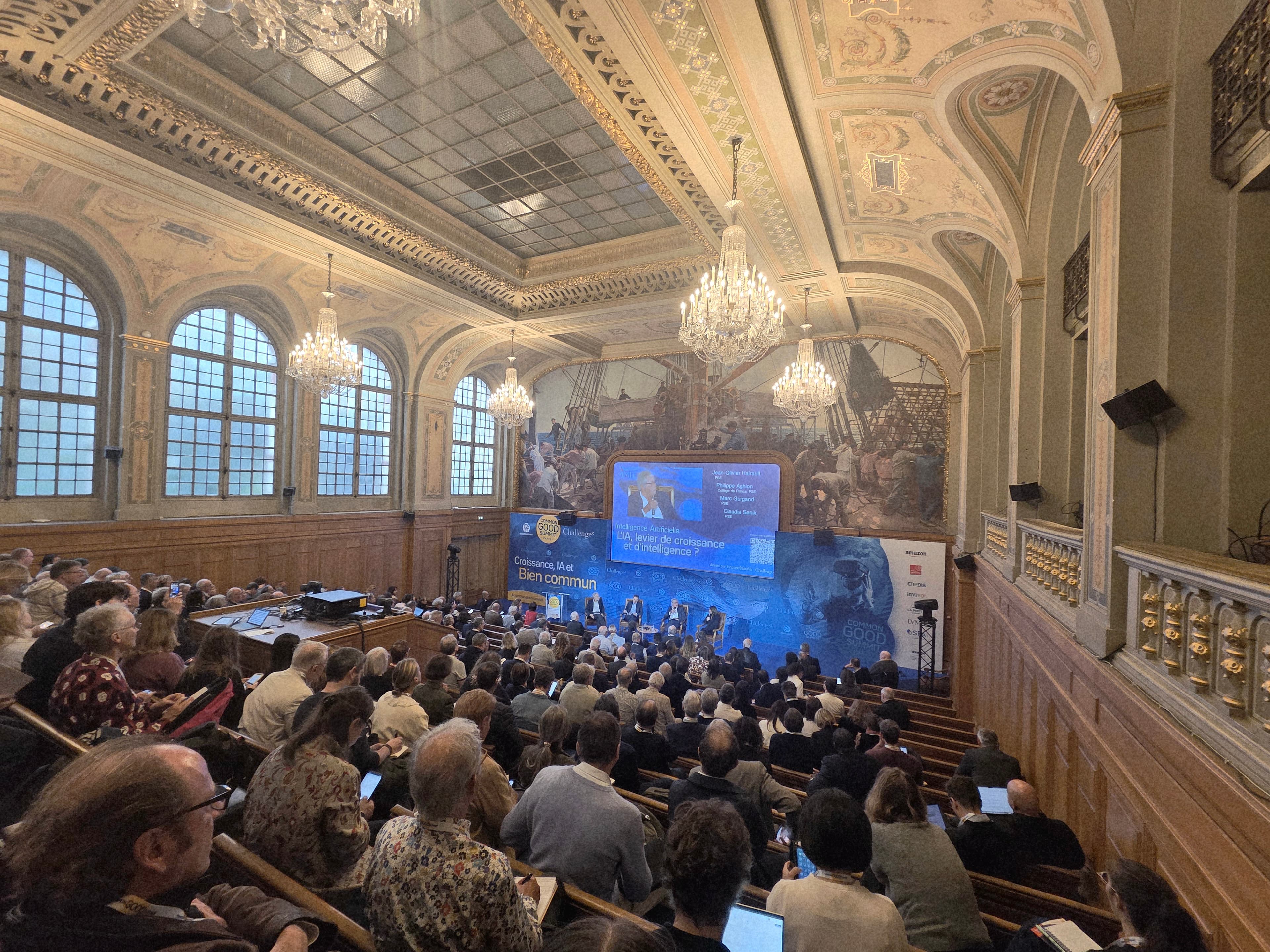
At the Maison de l'Océan, during the AI for the Common Good Summit organized by Challenges, Étienne Klein once again pulled the debate back to where it belongs: not the lies AI might spread, but the "fake" it helps to construct.
Here are the few notes I took during this fascinating debate between, on one side, a didactic Étienne Klein and, on the other, a pessimistic Bruno Le Maire and a pragmatic Louis Dreyfus (Le Monde).
The distinction between lie and fake is essential. A lie assumes an intent to deceive, a hidden truth, a game between the one who knows and the one who does not. The "fake", by contrast, often spreads without ill intent, carried by algorithms that exploit our cognitive weaknesses and by a technology unable to tell the true from the plausible. For the physicist-philosopher, the danger lies less in the machine than in our own vulnerability to it.
Klein starts from an uncompromising observation: our brain is biologically programmed to favor the simple, the spectacular, the reassuring. AI, by optimizing engagement, only amplifies that tendency. It does not create the "fake". It reveals it, by offering us narratives that, because they flatter our expectations, seem truer than reality itself. When 17% of French teenagers doubt that the Earth is round, the problem is not only the error, but the collapse of the mechanisms that should protect us from it. We are no longer in ignorance, but in an inability to understand how knowledge is established.
The "fake" as a symptom of a cognitive crisis For Étienne Klein, the distinction between cybernetic intelligence and critical intelligence is at the heart of the problem. AI excels at the first: it processes data, computes correlations, predicts behavior. But it knows nothing of the second, the intelligence that questions, doubts, and puts things in context. And it is precisely that intelligence that lets us resist illusions. By delegating part of our thinking to tools as powerful as they are blind, we risk confusing efficiency with truth.
The example of chatbots is telling. When a user asks an AI about a divisive subject, the answer will be optimized to please, not to enlighten. It will reflect the biases of the data it was trained on, and also those of the user, creating a vicious circle in which each camp sees its beliefs confirmed. Public debate is no longer a space where ideas confront one another, but an archipelago of parallel realities, made incommensurable by the absence of shared references.
Klein insists on a crucial point: the "fake" is not a bug, but a direct consequence of how these systems work. They do not lie. They manufacture the plausible. And the plausible, when it is spectacular, almost always wins out over the true, especially when the true is complex or disappointing.
(This is, of course, an absolutely crucial angle for brands in how they approach their visibility and authority on AI search engines, as you may have read in my other articles)
AI as an accelerator of democratic fragmentation The debate with Bruno Le Maire and Louis Dreyfus brought a twofold threat into focus. On one side, the emergence of an "algorithmic citizenship", in which essential decisions — access to credit, to employment, to public services — are made by black boxes, with neither transparency nor recourse. On the other, a growing polarization of the public sphere, where dialogue gives way to permanent confrontation. Algorithms, by locking us into confirmation bubbles, do not merely show us what we want to see: they keep us from seeing the rest.
Yet, as Louis Dreyfus pointed out, the AI giants are beginning to look for guardrails. By relying on reliable media to source their answers, they implicitly acknowledge the limits of their model. But this solution, useful as it is, is not enough. It restores neither trust in institutions nor the capacity for critical thought that is the foundation of democracy.
Klein reminds us that technology is never neutral. It reflects and amplifies our deepest tendencies. Faced with machines that do not understand but calculate, our only advantage remains our capacity to think — provided we do not delegate it.
Resisting the "fake": a cultural challenge above all The answer cannot be technical alone. It has to pass through a rehabilitation of critical thinking, an education that teaches not only how to know, but how one comes to know. That means slowing down, sourcing, comparing viewpoints, learning to doubt again. In short, cultivating that French intelligence the algorithms will never be able to replace.
The question, then, is not only how to regulate AI, but how to regulate ourselves. How do we restore a culture of doubt in a world designed for the absence of friction? How do we give value back to complexity, when everything pushes us to favor simplicity?