The rise of the Universal Commerce Protocol (UCP): toward a unified infrastructure for transactional AI.
Backed by leaders such as General Mills, Johnson & Johnson, and Kenvue, this protocol aims to create the "common language" between AI and e-commerce platforms.

Antoine HeftlerCo-founder
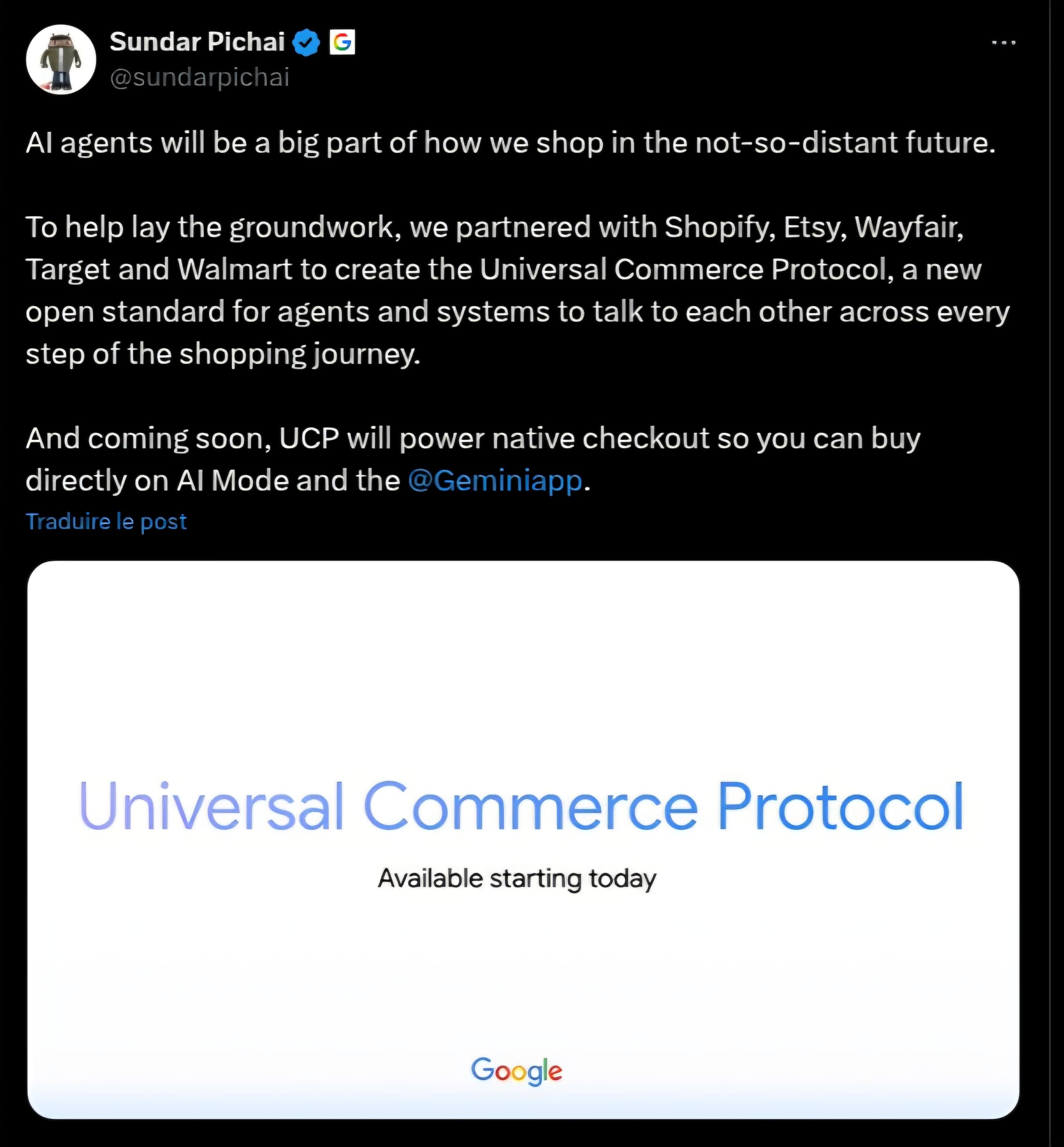
Backed by leaders such as General Mills, Johnson & Johnson, and Kenvue, this protocol aims to create the "common language" between AI and e-commerce platforms.
UCP is not a simple format update. It is a communication protocol designed to turn AI into a genuine transactional agent. Technically, it rests on three pillars:
-
Standardization of data (Universal Primitives): UCP defines strict units of information (price, stock, discounts) and lets an AI compare offers from heterogeneous sources without misreading them. - Interoperability (Model Context Protocol): the protocol lets models (Gemini, GPT) connect your product databases directly to their reasoning.
-
Securing the purchase: by integrating agent payment protocols, UCP lets AI complete a transaction securely on your behalf.
For brands, the move to UCP follows a path with three key stages:
-
Semantic normalization of data The first step is to turn your classic product pages into "Structured Data" compatible with UCP standards (often based on enriched JSON-LD schemas) and to clean your product attributes (price, SKU, discounts) so they match the Universal Primitives.
-
Opening up through "AI-Ready" APIs UCP depends on AI agents being able to query your systems in real time. You therefore need to build or adapt your APIs so they support protocols such as the Model Context Protocol (MCP). That lets a model (for example, Gemini) check stock or validate a promotion without the user having to visit your site.
-
Validation of "Semantic Trust" (authority) AI agents will only process transactions for brands they judge reliable. UCP includes source-verification mechanisms. Action: align your brand discourse across every touchpoint. If the AI detects a contradiction between your official site and your UCP data, it will downgrade your offer.
Objective: make sure your brand is recognized as the primary authority for its own products.
At ResonanceMetrics, this is exactly the extraction capacity we analyze. Is your content ready for this transition? Does your brand have the semantic authority required to be chosen by these new shopping agents? So, shall we talk?